
Last year, Team Tumbleweed’s engineers in Delft made a big change: To enable the rover’s powerful unfolding mechanism, they moved from 3D printed parts to machine-milled metal. This past year has not only seen a shift in materials, but a fundamental change to the prototyping process.
As our engineers develop the Tumbleweed Mars rover, different aspects of the structure – the outer arcs, the connecting sails, the electronics – move into focus. Over the past two years, the rover’s unfolding mechanism has been central to the work of our engineers in Delft. When descending toward the Martian surface, the Tumbleweed rover must unfold into its characteristic spherical shape at precisely the right time to ensure a smooth landing. The engineering of this complex and novel process has gone through many changes as our engineers learn more about what works – and what does not – through new designs and repeated testing.
In earlier iterations in the prototyping process, 3D printing machines supplied the pieces, allowing for quick changes and easy adaptation. However, the printed materials were becoming insufficient to withstand the immense forces during tests, as explained by engineer Ben in a previous blog post. Last year, we made a big switch, from 3D printer to a computer numerical control (CNC) mill, provided to the team by German company CNC-Step.
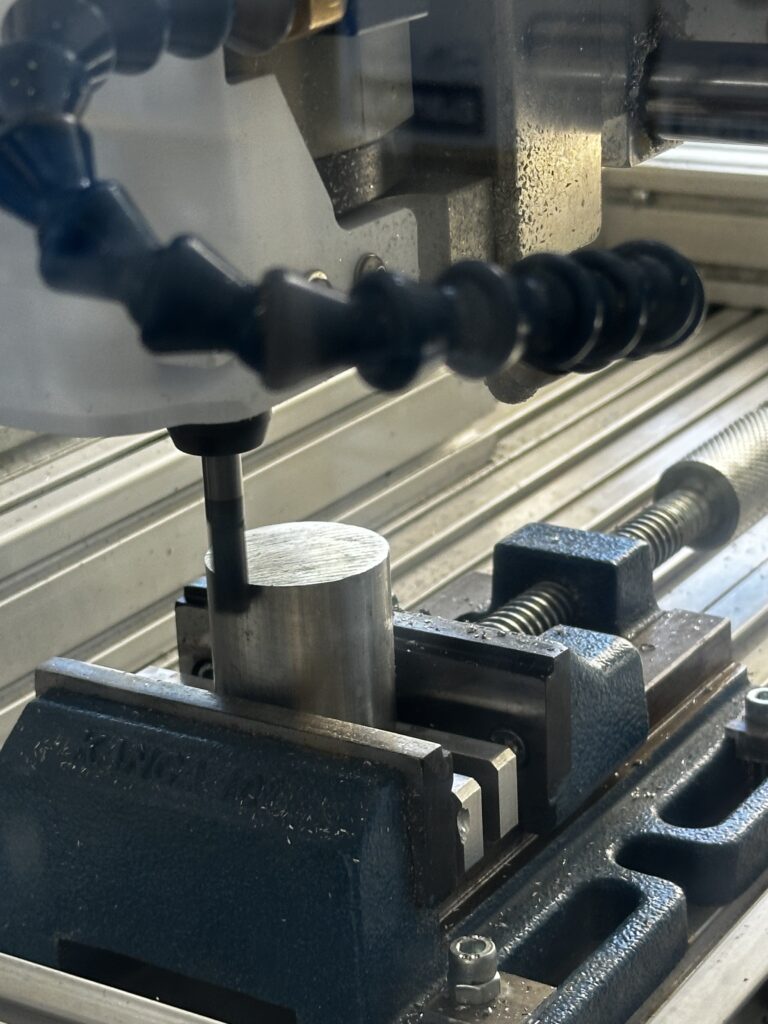
Controlled by input from a computer, it cuts metals into precise shapes, allowing our engineers to switch to more durable aluminium parts. For Team Tumbleweed engineer Sabin, this was the first time working with a CNC machine. Through the support of other members, he learned to master the tasks – but not as quickly as expected: “It was a lot more difficult than I thought. We had been 3D printing quite a lot, it’s quick, problems are easy to solve. With the CNC, suddenly we had to define all of these different coordinate systems and think about every single movement of the tool head.”
To get the hang of working the machine, learning to program the CNC is crucial. Like this, the paths that the tools will follow to shape the piece can be set. Different operations require different tools, making the creation of individual pieces significantly more complex than with a 3D printer. Sabin recalls his drastic learning curve: “It took us a month and a half to make the first part but eventually we reached the point where we managed to make three parts in one day.”
No longer having to iterate on the design, it was the perfect time to switch to a slower prototyping process. From the many tools available, Sabin highlights the z-height finder as particularly useful. Measuring the tool length and the part’s top surface, the z-height finder allows for simpler definition of the coordinate systems.
Aside from successfully strengthening the rover’s unfolding mechanism, Sabin is excited about the wide range of possible applications. In working with the CNC mill, the team has even found unexpected uses: To complete its unfolding sequence, the Tumbleweed rover needs extremely powerful springs. Using the CNC machine, Sabin and his colleagues were able to mill custom springs from a spring steel sheet.
Having expanded his skill set, Sabin “It is very satisfying to watch the CNC machine work, watching your idea come to life. You start with this block, then you have to think about all the ways it will cut the surface – and then it does exactly what you say. It requires patience, but I also learned that persevering pays off.”
Thank you to CNC-STEP for their support of the team by providing us with the CNC-STEP High Z-S400T. To learn more about their products, visit cnc-step.de.
For further information, please contact office@teamtumbleweed.eu.