
Each year, the International Astronomical Congress (IAC) brings together space actors from all across the globe. The 77th edition takes place in Antalya, Türkiye, from 5–9 October 2026.
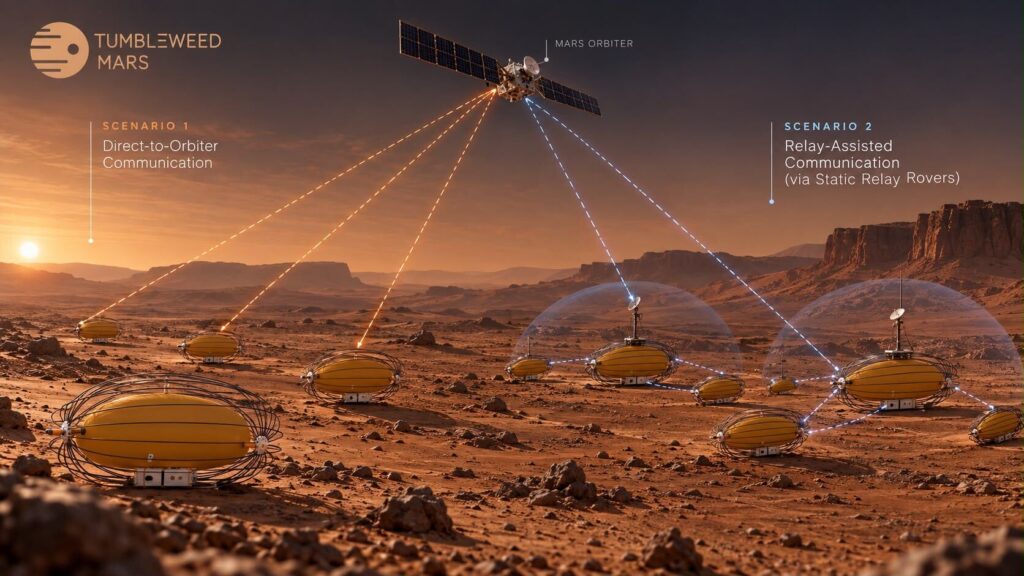
With teams working on both the engineering aspects of a novel Mars rover, as well as the science opportunities posed by such a mission, Tumbleweed Mars has presented a variety of papers on our progress (find them here). For IAC 2026, our Research & Development (RnD) team has submitted the paper “An Autonomous Scheduling Framework for Relay Access in a Large-Scale Mars Rover Swarm”, focusing on the data sent from the Tumbleweed rovers to Earth.
Aybüke Sude Buzkıran, who works on Mars rover telemetry and scheduling, shares more about her and the team’s work.
The Tumbleweed Mars mission approaches the exploration of the Red Planet in a completely new way: rather than one rover moving slowly across the Martian surface, taking detailed measurements, a whole swarm covers larger areas to quickly gather information, such as images, atmospheric data, or temperature readings, in many different locations.
However, the amount of data gathered also leads to constraints. “Rather than sending their data directly to Earth, rovers on the surface of Mars mostly use communication satellites orbiting Mars as a kind of ‘relay station’. The rover sends the data to the satellite, which then relays it to Earth,” Aybüke explains. As communication time and bandwidth limit the amount of data that can be returned to Earth, our engineers must design a system which decides what information is sent back.
Aybüke compares this to a traffic management system. Rather than every rover constantly trying to transmit all of its data, the system autonomously prioritises it. For this, it uses machine learning to consider factors such as the scientific value of the data and how long the rover has been waiting to communicate.
The technology Aybüke has devised is not only useful for the Tumbleweed Mars mission: With more rovers operating on the planet in the future, this system “aims to enable the rovers to share their limited communication resources more intelligently amongst themselves.” The technology could even be extended to multi-rover missions on other objects in our solar system, such as the Moon.
This year’s IAC has an added personal dimension for the team: Both Aybüke and RnD lead Tolga Ors are from Türkiye. Aybüke is excited to be presenting her team’s work to the international space community on home turf at the event: “I believe that the questions and feedback we receive from researchers specialising in this field will be particularly valuable for the next phase of our work.” For her, IAC is only the next step before expanding the simulations to include more realistic mission conditions and more closely examine how conditions affect the algorithm’s performance.
For further information, please contact office@teamtumbleweed.eu.